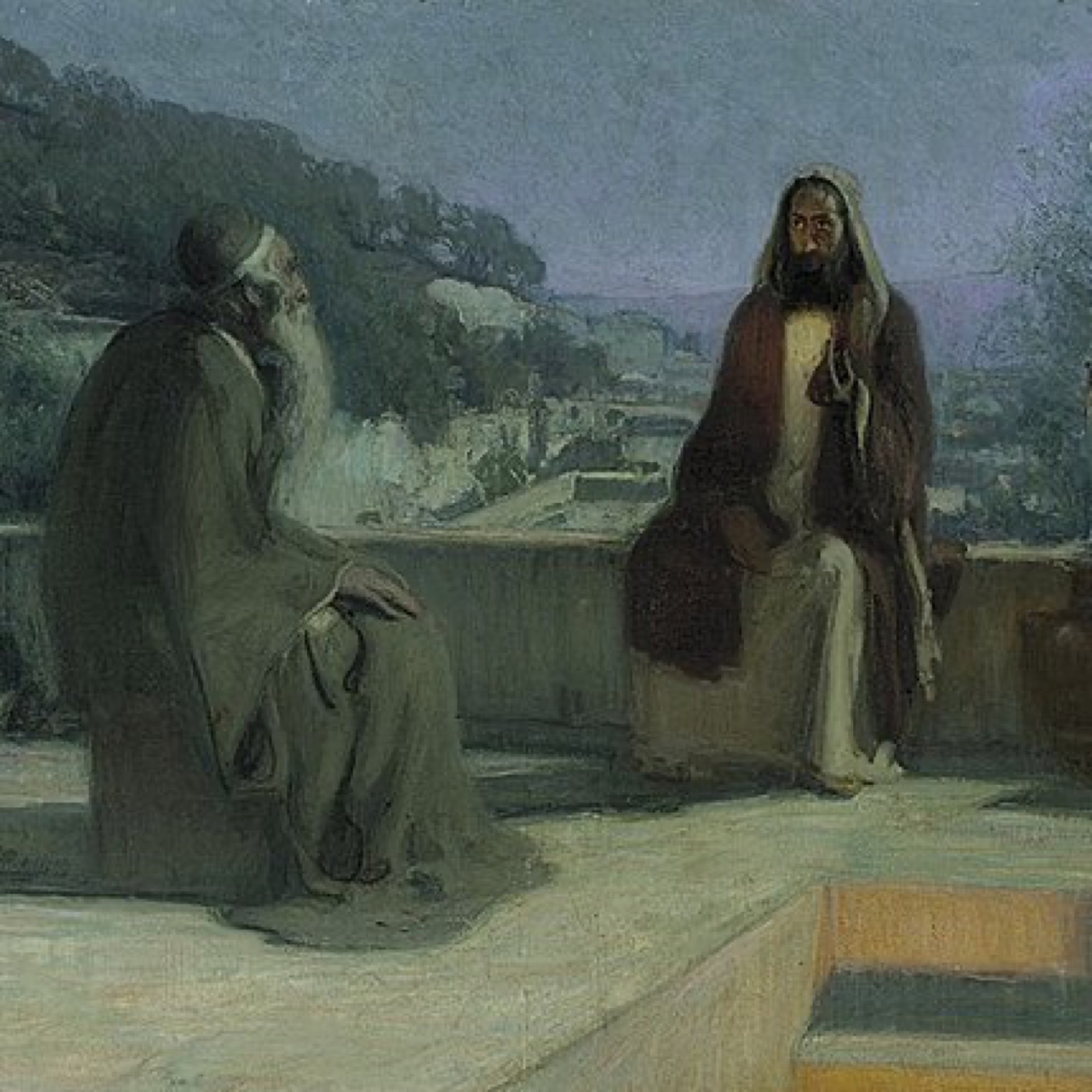
What Nicodemus Gave Up
Three things in particular strike me about this Gospel. One is that much of it revolves around discourses challenging hearers to examine that which they know. The second is that John’s Gospel is filled with the politics of oppression and rebellion—Jesus and Nicodemus move in secret, there are repeated attempts to arrest Jesus and Jesus’ repeated escapes, there are trials, testimonies, judges, betrayals, persecutions, and detachments of soldiers with their lanterns, torches, and weapons. Third, much of the action takes place in Jerusalem during major Jewish festivals.
What Nicodemus and Ernesto Cardenal Gave Up
TEXTS:
Jn 3:1-21
Jn 7:50-51
Jn 19:39-42
Nicodemus Visits Jesus
“Now there was a Pharisee named Nicodemus, a leader of the Jews.
He came to Jesus by night and said to him, “Rabbi, we know that you are a teacher who has come from God; for no one can do these signs that you do apart from the presence of God.”
Jesus answered him, “Very truly, I tell you, no one can see the kingdom of God without being born from above.”
Nicodemus said to him, “How can anyone be born after having grown old? Can one enter a second time into the mother’s womb and be born?”
Jesus answered, “Very truly, I tell you, no one can enter the kingdom of God without being born of water and Spirit.
What is born of the flesh is flesh, and what is born of the Spirit is spirit.
Do not be astonished that I said to you, ‘You[d] must be born from above.’
The wind blows where it chooses, and you hear the sound of it, but you do not know where it comes from or where it goes. So it is with everyone who is born of the Spirit.”
Nicodemus said to him, “How can these things be?”
Jesus answered him, “Are you a teacher of Israel, and yet you do not understand these things?
“Very truly, I tell you, we speak of what we know and testify to what we have seen; yet you do not receive our testimony.
If I have told you about earthly things and you do not believe, how can you believe if I tell you about heavenly things?
No one has ascended into heaven except the one who descended from heaven, the Son of Man.
And just as Moses lifted up the serpent in the wilderness, so must the Son of Man be lifted up,
that whoever believes in him may have eternal life.
“For God so loved the world that he gave his only Son, so that everyone who believes in him may not perish but may have eternal life.
“Indeed, God did not send the Son into the world to condemn the world, but in order that the world might be saved through him.
Those who believe in him are not condemned; but those who do not believe are condemned already, because they have not believed in the name of the only Son of God.
And this is the judgment, that the light has come into the world, and people loved darkness rather than light because their deeds were evil.
For all who do evil hate the light and do not come to the light, so that their deeds may not be exposed.
But those who do what is true come to the light, so that it may be clearly seen that their deeds have been done in God.”
John 7:50-51
Nicodemus, who had gone to Jesus before, and who was one of them, asked,
“Our law does not judge people without first giving them a hearing to find out what they are doing, does it?”
Jn 19:39-41
Nicodemus, who had at first come to Jesus by night, also came, bringing a mixture of myrrh and aloes, weighing about a hundred pounds.
They took the body of Jesus and wrapped it with the spices in linen cloths, according to the burial custom of the Jews.
Now there was a garden in the place where he was crucified, and in the garden there was a new tomb in which no one had ever been laid.
The story of Nicodemus is part of the fabric of John’s Gospel. Three things in particular strike me about this Gospel.
One is the degree to which much of it revolves around discourses in which people are challenged to examine that which they know.
The second is that John’s Gospel is filled with details of the politics of oppression and rebellion—Jesus moves in secret, Nicodemus moves in secret, there are repeated attempts to arrest Jesus and Jesus’ repeated escapes, there are trials, testimonies, judges, betrayals, persecutions, and detachments of soldiers with their lanterns and torches and weapons.
Third, much of the action takes place in Jerusalem during major Jewish festivals.
Off-season, Jerusalem was a major metropolitan area set within a wall measuring about 4 miles in circumference. Within the walls lived a permanent population of perhaps 80,000 people including thousands of temple priests, their attendants, and temple police.
During the festivals, however, the population would swell to include as many as 250,000 pilgrims, along with thousands of terrified animals necessary for the festivals. Jerusalem during festival times was extremely crowded and noisy, people were overly excited and every corner bar did a land office business. Roman security was added at every gate and at the Temple, Jewish police officers were on the lookout for trouble makers. Every festival had the potential for trouble.
On top of this, Temple and Jewish leadership, including the Pharisees, existed at the pleasure of the Roman Empire. The job of the leadership was two-fold.
First, it was to maintain Jewish law and ritual, and thereby maintain the ability of Jews to exist as a people of faith within an empire that was hostile to them. This in part was what made them exemplary Jews—exemplary men of faith.
Second, their job was to keep the lid on Jewish rebellions so that the Jews could continue to exist as a political entity. So, in essence, the Pharisees had struck a bargain with Rome—allow us to exist as a people and a faith, they seem to have concluded with much justification, and we will keep Jerusalem rebellion-free. At best, the Pharisees had a difficult, unenviable job.
The difficulty of their job could only have increased during the times of the major festivals—Passover, the feast of Tabernacles, and the feast of Dedication because what were these festivals commemorating?
Political liberation.
Passover celebrated the liberation from Egypt, the fundamental event in Israel’s history.
The feast of Tabernacles celebrated God’s protection of Israel in the wilderness.
The feast of Dedication celebrated God’s deliverance of Israel from the oppression of Antiochus Epiphanes and the cleansing of the Temple by the Maccabees.
And this is the volatile situation into which John’s Jesus Christ inserts himself. As Passover is drawing near, he goes up to Jerusalem, enters the temple, which has tightened its security, makes a whip out of cords and uses it to cleanse the temple.
Adding insult to injury, he pours out the coins of the money changers and overturns their heavy tables shouting, “Take these things out of here! Stop making my Father’s house a marketplace!”
It is after this that Nicodemus comes secretly, by night, to Jesus. One of the Pharisees whose job it is to maintain Jewish law and the Jews’ right to exist within a hostile empire, Nicodemus is a man of serious faith. He asks Jesus to clarify his theology of being born again, in other words, of what it means to be born anew into fullness of life.
Nicodemus, it occurs to me, is beginning to question whether the bargain struck with Rome will ever result in the kind of true liberation which was at the core of these major Jewish festivals. I think he may be questioning whether the bargain with Rome is a bargain for life or a bargain for death. At the close of Jesus’ discourse, this intensely political Jesus identifies himself as the full-blown apocalyptic Son of Man sent by God to liberate the whole world.
And it seems to me that Nicodemus is beginning to conclude that the bargain the Jewish leadership has made with the Romans is a devil’s bargain. I think he has begun to conclude that oppression by definition cannot possibly be the solution for oppression.
Months later, during the festival of Tabernacles during which the faithful read Liberation Song 118 (sometimes known as Psalm 118), Jesus cries out, “let anyone who is thirsty come over to me.” And in what is a real shock to the chief priests and Pharisees, even the temple police begin to believe that Jesus is a prophet or even the long-expected messiah.
Even one of their own, Nicodemus, says that Jesus needs to be given a hearing.
The people are going over to Jesus. The temple police appear to be going over to Jesus. And now, Nicodemus, a Pharisee, is going over to Jesus. And the Pharisees’ anxiety begins to skyrocket. “Search the scriptures,” they say. No prophet will ever come out of Galilee.”
So the chief priests and Pharisees call a meeting and say “What are we to do? If we let this man go on like this everyone will believe in him, and the Romans will come and destroy both our holy place and our nation.”
And Passover comes around again, and many ordinary Jews are deserting to Jesus and believing in him. And when Jesus enters Jerusalem on the colt of a king and the crowd greets him with shouts of “The King of Israel!” the Pharisees say to one another, “Look, the whole world has gone over to him!”
And in a desperate effort to hold onto their authority, the Pharisees begin to excommunicate those who go over to Jesus. And they assist the Roman soldiers in their arrest of Jesus who is tried and crucified.
I think that it is a testament to the degree to which Nicodemus has changed his orientation that, along with Joseph of Arimathea, it is he who takes care of Jesus’ body, bringing about 100 pounds of myrrh and aloes to place inside the burial linens, according to Jewish custom.
And this is on the day of Preparation, the day when Jews remember that freedom day when Israel prepared to leave Egypt.
This is one way to recall Nicodemus this Easter. As one who examined that good thing which he as a good Pharisee knew, that good thing he gave up in order to claim the freedom, the liberation which had been promised by God.
I am struck by how much Nicodemus’ pursuit of holistic liberation reminds me of Nicaragua’s Ernesto Cardenal. For those of you who don’t know about him, Cardenal is one of the most widely-read poets in the Spanish language and a Roman Catholic priest.
To understand Cardenal, you need to know that throughout most of the twentieth-century, Nicaragua was the U. S.’s primary Latin American client state. The US installed and militarily backed the brutal Somoza regime, one of the most brutal of all the military dictatorships in Latin America.
I don’t think its hyperbolic to say that Nicaragua existed at the pleasure of the U. S. Nor is it hyperbolic to say that the Catholic Church in Nicaragua existed at the pleasure of President Somoza and the Nicaraguan National Guard.
So, in my mind, there is something of a parallel between the relationship of the Nicaraguan Church to the U. S. and the relationship of the Jewish Temple leadership to the Roman Empire.
As a young adult, Cardenal participated in a plot to overthrow the Somoza / National Guard dictatorship. However, because of the excessive violence of the reprisals against the rebellion, like Nicodemus, Cardenal had a “born again” experience in which he disavowed violence and decided to enter the priesthood.
He went to Kentucky to study philosophical non-violence with Thomas Merton. At Merton’s urging, Cardenal later returned to Nicaragua where he founded a commune devoted to contemplation, the arts, and strict non-violence.
Along with Daniel and Phillip Berrigan as well as Thomas Merton, Cardenal became one of the key figures of the philosophical non-violence movement. Philosophical non-violence was indeed that which made them such exemplary Christians. It was a principle they knew was right.
But by 1972, Cardenal reluctantly concluded that priestly calls for non-violence would not end violence. Indeed, he began to conclude, it would only prolong the intense suffering of the Nicaraguan people.
And so Cardenal scandalized his international admirers with a decision to publicly support the guerrillas who were gathering strength in their effort to overthrow the Somoza / National Guard dictatorship. He longed for fullness of life for Nicaragua and concluded that hope for Nicaraguan life was inconsistent with philosophical non-violence and its bargain with the dictatorship.
His decision was most welcome among the young guerrillas with whom he read and discussed the Bible at the front and among many other Christians in Latin America.
Yet, it was most unwelcome among good Christians outside Latin America including Daniel Berrigan and Pope John Paul II whose criticism was especially hurtful. When I see video footage of the Pope wagging his finger at a kneeling Ernesto Cardenal on a public runway in Managua, I hear an anxious caution from the Pope:
“Surely, no prophet will ever come out of Nicaragua!”
As with Nicodemus’s turn from that principle on which he had staked a calling and a career, Cardenal’s turn from non-violence coincided with preparations for a major Christian festival. On the morning of December 23, 1972, a violent earthquake struck Managua as the city’s elite were preparing for a lavish Christmas. Later, Nicaraguan poet Tomás Borge wrote that Managua shattered “like a castle of cards constructed by a Peruvian sorceress.”
Approximately 10,000 people were killed. Hundreds of thousands more were injured or left homeless. The devastation to property was nearly incalculable.
National Guard soldiers, often led by their officers, engaged in extensive looting. They enjoyed tormenting desperately hungry people chasing them by showing them tin cans of food which they would not give up.
Massive amounts of foreign aid poured into Nicaragua. Most of it ended up in the already deep pockets of Somoza, his family, and his business and Guard cronies.
Cardenal concluded that the Nicaraguan Church’s bargain with the National Guard and Somoza would never lead to fullness of life for Nicaragua. Cardenal, like Nicodemus, responded to a political temple-cleansing Jesus who was the full-blown, apocalyptic, Word Become Flesh, Son of Man. He recalled Liberation Psalm 118 and Mary’s Christmas Magnificat and became reborn once again.
We are entering into the final days leading up to the major festival of the Christian calendar, the Easter festival, the festival during which we Christians celebrate more than any other the promise that fullness of life can overcome even the politics of death. It seems appropriate that we remember Nicodemus and Ernesto Cardenal. It seems appropriate that we recall that the political Jesus who cleansed the temple and died on the cross is the apocalyptic Son of Man sent to bring the whole world liberation.
Most importantly, it seems appropriate during what remains of this Lenten season that we, too, examine that which makes us a good Christian.
If being a good Christian is inconsistent with the full liberation of the whole world, are we prepared to give it up?
← All sermons