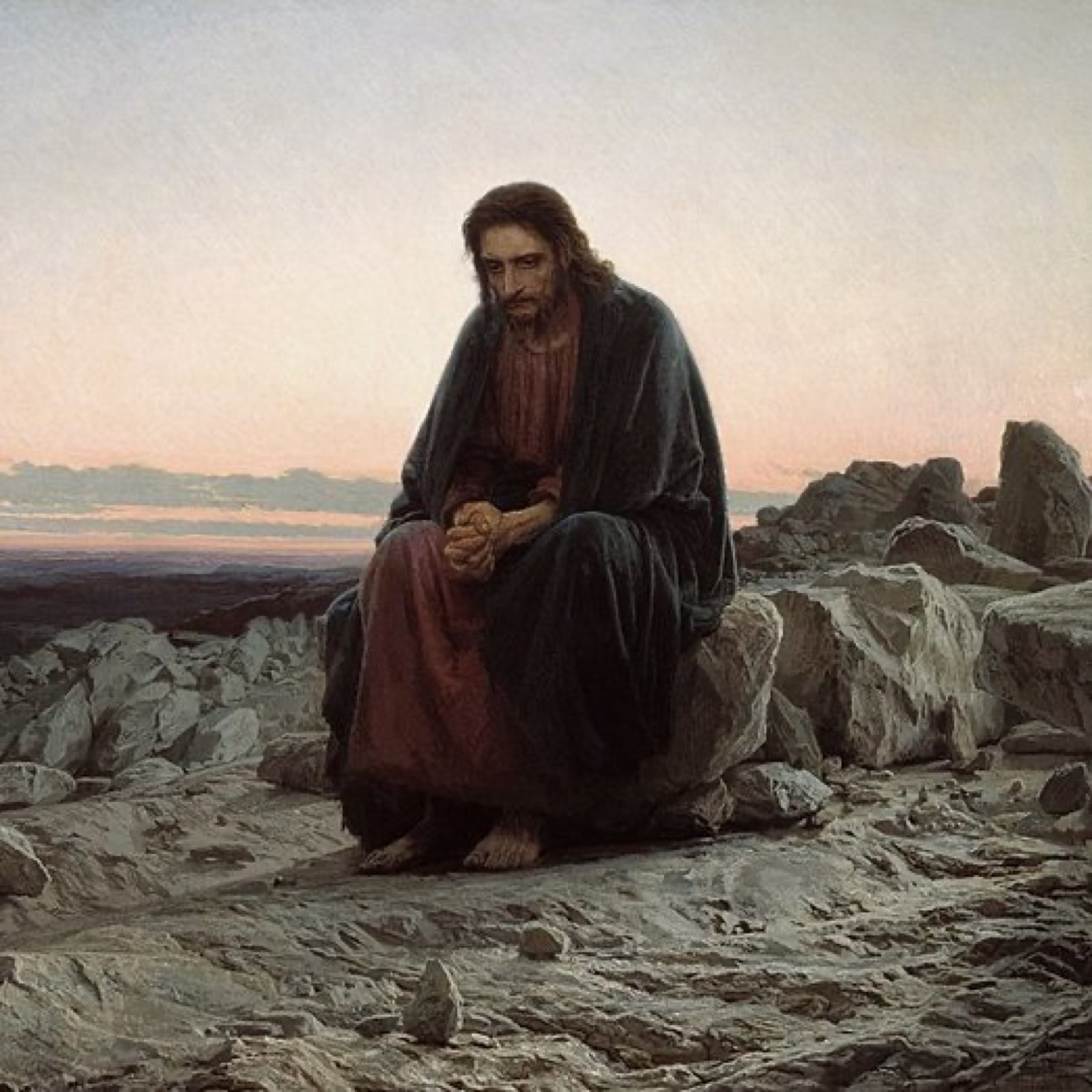
Tempted by Glory
Psalm 91:1-2, 9-16 · Luke 4:1-13
The story of the temptations of Jesus in the wilderness is predicated on the fact that Jesus has already been established in Luke’s Gospel as the Son of God.
That has been established.
To understand what that claim about Jesus means, though, we have to understand what the claim meant in the context of the Roman Empire. Jesus was making not only a spiritual claim, he was making a political claim. By the time of Jesus’s birth, the position, if not the person, of Caesar had been deified. By the time Augustus was Caesar, the person of Caesar had been deified. Augustus began to be worshiped as a deity, somewhere between a “Divine Son” and a “Son of God”. Augustus used this title to advance his political position finally overcoming all rivals for power within the Roman state.
The point is, the title “Son of God” was not exclusive to Jesus. By the time of Jesus’s ministry, the other Son of God was Caesar Tiberius whose power extended over many political realms.
Having a better understanding of what the claim Son of God meant in its contemporary context, we can begin to get at what Luke was up to with his story.
One of Luke’s storytelling techniques is the use of allusion. He mentions a word or a phrase and it recalls to mind entire episodes that the hearers of his story will immediately understand. And they’ll make connections. Luke begins the story of the temptations Jesus faced this way:“Jesus, full of the Holy Spirit, returned from the Jordan (where he had just been baptized) and was led by the Spirit in the wilderness, where for forty days he was tempted by the devil.” Luke is reminding the hearer of his Gospel that Jesus is the Son of God as signified by the story of his baptism in the Jordan River. He is also setting us up with interpretive tools for the story of Jesus’s temptations in the wilderness. One of those interpretive tools is Luke’s use of the number “40”.
For those of you who have been exposed to Bible stories for a while, the number 40 may conjure the rains which flooded the earth for 40 days and 40 nights in what we now call the Flood Story of Noah and the Ark way back at the beginning of Jewish time. It may conjure the story of Moses being told by God to come up on a high mount way up into the clouds where he would receive the terms of the covenant offered by God, and he stayed there for 40 days and 40 nights. And, it may conjure the broader Mosaic story of the Israelites wandering in a wilderness for 40 years.
All of which to say that the number 40 and the stories to which it alludes and the connections it evokes, connect Jesus backwards to his ancestors in the people, the politics, and the faith of Israel and forward to the story which is about to unfold. The number 40 also reaffirms the claim that Jesus is the authentic Son of God. 3. Keep your eyes on this: that Jesus was led by the Spirit in the desert. Listen out for “Jesus was led” in the rest of the story. The phrase becomes a motif and motifs are developed for a reason.
So, for 40 days Jesus was tempted by the devil. Now, look at what is going on here. In the first part of the sentence, “Jesus, full of the Holy Spirit, returned from the Jordan . . . . “. Who is the protagonist here? Jesus. He returns. He’s his own man in charge of his destiny in the active voice. But no sooner has he returned than there is a plot twist: the protagonist suddenly becomes the Spirit. Active voice. Jesus becomes the antagonist operating in the passive voice. And this is where he stays for a good part of the story—he is no longer the protagonist of the story. Why? Because he is being tempted.
Now, we need to hit the pause button for a minute and reflect on what it means to be tempted. Temptation has to do with desire. Desire is the strong want to do something or have something, especially something that is unwise or wrong. What this means is that Jesus desires in a strong way the things the devil is holding out to Him, if only momentarily. Without the aspect of Jesus’s desire for these things, there is no temptation, and the story falls apart. The devil tempts Jesus; Jesus is tempted.
The framework for the first thing which tempts Jesus is the wilderness where for 40 days, Jesus fasted. He ate nothing at all and when his fast was over, he was famished. He wanted something to eat. He needed something to eat. The devil begins to tempt him by challenging Jesus’s claim that he is the Son of God. He is challenging both Jesus’s religious claim and his political claim. Because the one true Son of God in the context of the Roman Empire was Caesar Tiberius. And the devil challenges him by toying with a sensitive spot—Jesus’s identity.
The word translated as “if”: “If you are the Son of God” can also be translated more sarcastically as “since.” “Since you are the Son of God” . . . with the implied “prove it.” Command this stone to become a loaf of bread. And wouldn’t Jesus love a loaf of bread right about now. Jesus is tempted to take the devil up on his challenge because he is hungry to the point of starvation and because he wants to settle the challenge to his identity. If Jesus is not actually tempted to turn the stone into bread, the story and its meaning fall apart.
Jesus overcomes the temptation by remembering who he is—he is a descendant of Moses and of those who were fed by God with manna, a previously unknown type of bread. So he finally rebukes the devil’s tempting by remembering the story told in Deuteronomy: “He humbled you by letting you hunger, then by feeding you with manna, with which neither you nor your ancestors were acquainted, in order to make you understand that one does not live by bread alone, but by every word that comes from the mouth of the Lord.”
Which is to say that we emphatically need bread to live—why else would God provide manna to the Israelites? But that there are other things we need, too, in order to thrive. Things like dignity, self-respect, and autonomy. Man does not live by bread alone.
But the devil is restless. The devil is always restless. Look at what happens next. The devil displaces the Spirit. The Spirit has exited the scene and is not coming back. The devil is fully protagonist now which is signaled by the phrase “the devil led him”. Just a second ago, it was the Spirit which led Jesus. Now, it is the devil. Does Jesus rebuke the devil? Does he say, “get thee behind me?” Absolutely not. Jesus literally follows the Devil up a mountain. Did we just hear about a mountain? Oh, yeah: Moses, God, the clouds, the Covenant. . . .
Up on that mountaintop, the devil shows Jesus all the kingdoms of the world. In the context of the dueling claims as to who is the Son of God, Jesus or Caesar, what does “the world” mean? It means the Roman Empire. Rome had once been a kingdom, then it was a republic. But by the time Jesus was on the scene, Rome was an empire. How do you become an empire? By subsuming other peoples’ lands’, their peoples, and their cultures and by controlling their religions. The devil promises Jesus all the kingdoms of the Roman world. The devil promises Jesus all the glory and and all the authority, and he makes the claim that all the glory and all the authority over the Roman world is his and he can give to anyone he pleases. It is a bold claim which raises the question: just who is this devil? He’s beginning to look an awful lot like Caesar.
Jesus is tempted. He is tempted by glory and authority over all the world. Because if he is not actually tempted, if he does not actually want the glory and the authority and all the kingdoms, the story and its meaning fall apart.
But then the devil discloses what will clinch the deal: all Jesus has to do is worship him. The devil is beginning to look an awful lot like a stand-in for Caesar. The deal clincher brings Jesus to his senses. He cannot worship the devil. As part of his own claim to being the Son of God, he cannot worship the devil. Jesus recalls an injunction from Deuteronomy: “ You shall fear the Lord your God; him alone you shall worship; to him you shall hold fast, and by his name you shall swear.”
But the devil is restless in his search for power and glory. The devil is always restless. He tries the third time. The devil leads Jesus to Jerusalem and literally places him on the pinnacle of the Temple, the Temple being the place where Jewish authorities were collaborating with Rome. Again the Devil challenges Jesus’s claim to being the Son of God: “if you are the Son of God” or “Since you are the Son of God”, throw yourself off the pinnacle. Then the Roman devil quotes Jesus’s own Jewish Scriptures with this passage from Psalm 91:
“For he will command his angels concerning you
to guard you in all your ways.
On their hands they will bear you up,
so that you will not dash your foot against a stone.”
And Jesus is tempted. Because if Jesus is not tempted, the story and its meaning fall apart. But Jesus remembered this caution from Deuteronomy: “Do not put the Lord your God to the test, as you tested him at Massuh.”
What’s this about Massuh? Massuh is a place mentioned in Exodus at the beginning of the time of the 40 years wandering. Because of the lack of water, the Israelites begin to complain about Moses, “Why did you bring us out of Egypt, just to kill us and our children and livestock with thirst? Is the Lord not with us?” So God tells him to go to a certain rock and strike it with his rod whereupon water gushes forth and the people drink. Moses called the place Massuh because they tempted the Lord to prove Himself even though, as he said in a retort, “you’ve already seen my work.” And the Lord said, “For forty years I loathed that generation and said, “They are a people whose hearts go astray, and they do not regard my ways.” Therefore in my anger I swore, “They shall not enter my rest.” Even God is tempted by glory and authority!
So Jesus quotes Scripture right back at the devil, “Do not put temptation out in front of the Lord your God.” And Jesus reminds the devil, unlike me God has been known to actually act on temptation which is something you really don’t want.” Fair warning. So the devil goes away. But he’s coming back. When an opportune time presents itself, he’ll be back. Later on Jesus will turn his temptations in the wilderness into a prayer of deliverance, “God, don’t lead us into temptations of glory and authority and kingdoms, but when we are tempted, deliver us from it. Because all the kingdoms and all the glory and all the power belong to you and you alone forever and forever.
Amen.
← All sermons