Limping Between Two Opinions
Texts:
2 Kings 2:1-12
Now when the LORD was about to take Elijah up to heaven by a whirlwind, Elijah and Elisha were on their way from Gilgal.
Elijah said to Elisha, "Stay here; for the LORD has sent me as far as Bethel." But Elisha said, "As the LORD lives, and as you yourself live, I will not leave you." So they went down to Bethel.
The company of prophets who were in Bethel came out to Elisha, and said to him, "Do you know that today the LORD will take your master away from you?" And he said, "Yes, I know; keep silent."
Elijah said to him, "Elisha, stay here; for the LORD has sent me to Jericho." But he said, "As the LORD lives, and as you yourself live, I will not leave you." So they came to Jericho.
The company of prophets who were at Jericho drew near to Elisha, and said to him, "Do you know that today the LORD will take your master away from you?" And he answered, "Yes, I know; be silent."
Then Elijah said to him, "Stay here; for the LORD has sent me to the Jordan." But he said, "As the LORD lives, and as you yourself live, I will not leave you." So the two of them went on.
Fifty men of the company of prophets also went, and stood at some distance from them, as they both were standing by the Jordan.
Then Elijah took his mantle and rolled it up, and struck the water; the water was parted to the one side and to the other, until the two of them crossed on dry ground.
When they had crossed, Elijah said to Elisha, "Tell me what I may do for you, before I am taken from you." Elisha said, "Please let me inherit a double share of your spirit."
He responded, "You have asked a hard thing; yet, if you see me as I am being taken from you, it will be granted you; if not, it will not."
As they continued walking and talking, a chariot of fire and horses of fire separated the two of them, and Elijah ascended in a whirlwind into heaven.
Elisha kept watching and crying out, "Father, father! The chariots of Israel and its horsemen!" But when he could no longer see him, he grasped his own clothes and tore them in two pieces.
Mark 9:2-9
Six days later, Jesus took with him Peter and James and John, and led them up a high mountain apart, by themselves. And he was transfigured before them,
and his clothes became dazzling white, such as no one on earth could bleach them.
And there appeared to them Elijah with Moses, who were talking with Jesus.
Then Peter said to Jesus, "Rabbi, it is good for us to be here; let us make three dwellings, one for you, one for Moses, and one for Elijah."
He did not know what to say, for they were terrified.
Then a cloud overshadowed them, and from the cloud there came a voice, "This is my Son, the Beloved; listen to him!"
Suddenly when they looked around, they saw no one with them any more, but only Jesus.
As they were coming down the mountain, he ordered them to tell no one about what they had seen, until after the Son of Man had risen from the dead.
2 Corinthians 4:3-6
And even if our gospel is veiled, it is veiled to those who are perishing.
In their case the god of this world has blinded the minds of the unbelievers, to keep them from seeing the light of the gospel of the glory of Christ, who is the image of God.
For we do not proclaim ourselves; we proclaim Jesus Christ as Lord and ourselves as your slaves for Jesus' sake.
For it is the God who said, "Let light shine out of darkness," who has shone in our hearts to give the light of the knowledge of the glory of God in the face of Jesus Christ.
Sermon
What I mean is that the church has a theological and a biblical obligation, an obligation which more often than not is ignored, which is to analyze our world through the lens of the Bible. If we don’t engage in that analysis, then in my opinion, we become the latest version of idol worshippers. So, when I read biblical passages, I am conscious of what words and images stick in in mind and where my mind goes outside the passages per se, and I embrace the connections I make. I don’t know about y’all, but I am one of those who wants to know the context of biblical stories. Yet, I am not one of those who believes we must only READ OUT the Bible, pouring the Bible into our eyes and ears and memory as a repository, always being careful not to read our own experiences or understandings INTO the Bible.
I also am not one of those who thinks that politics has no place in church. Of course, I do not want to be met at the church door by a political pin wearing usher, nor do I want to be told how to vote. That is not what I mean. What I mean is that the church has a theological and a biblical obligation, an obligation which more often than not is ignored, which is to analyze our world through the lens of the Bible. If we don’t engage in that analysis, then in my opinion, we become the latest version of idol worshippers.
So, when I read biblical passages, I am conscious of what words and images stick in in mind and where my mind goes outside the passages per se, and I embrace the connections I make
This is the biblical context for Elijah. According to the Bible, the greater context for the emergence of Elijah is this: Israel had made religious compromises in order to secure national security and economic prosperity for the elites. But national security and economic prosperity for the elites did not produce peace.
Along comes King Ahab, who stood in a long line of kings of Israel, and princess Jezebel who was a priestess of what Elijah considered to be a false god: Ba’al. She built a temple for Ba’al and brought in its priests and prophets. Ba’al was the Canaanite god responsible for rain, thunder, lightning, and dew.
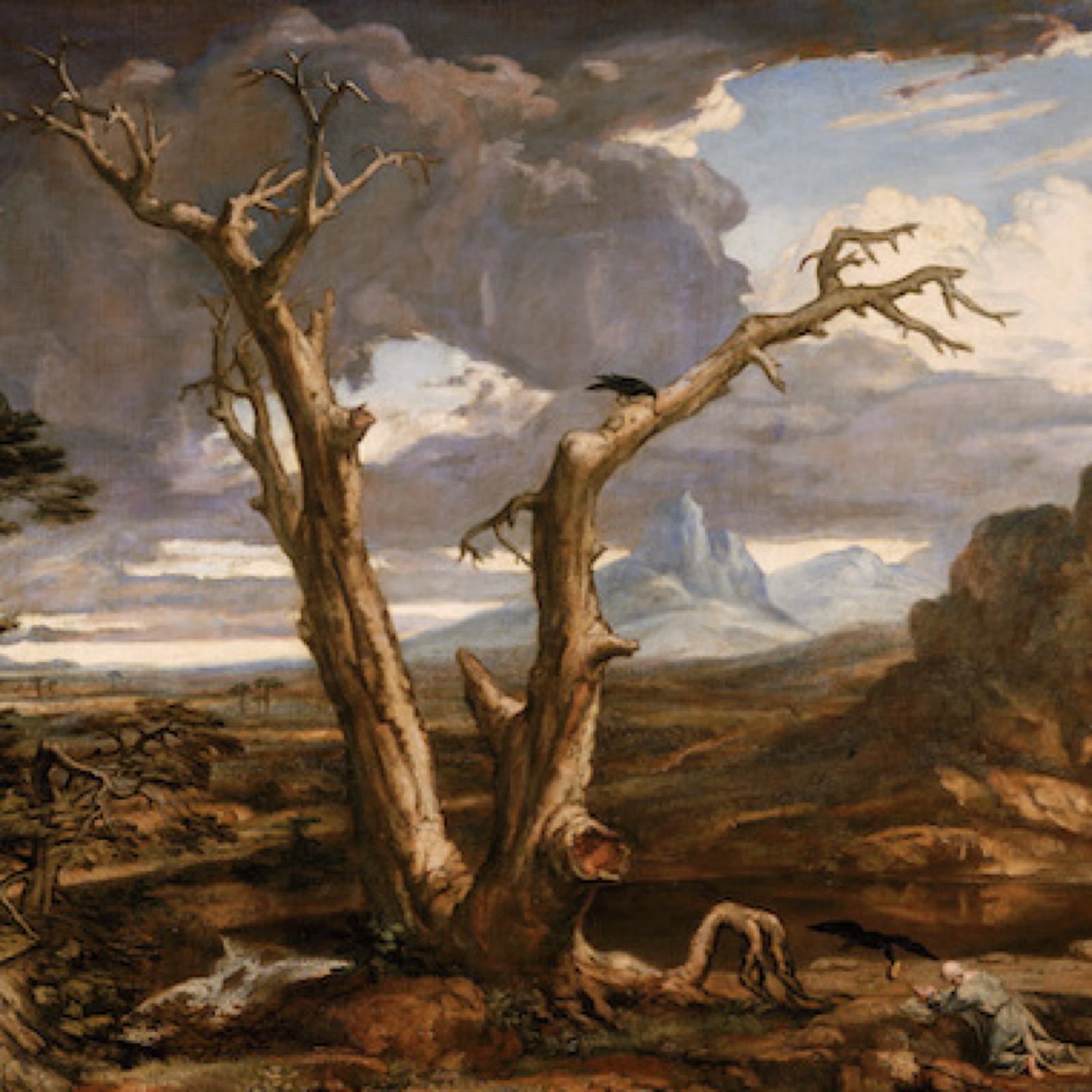
Enter Elijah who challenges both the king and the king’s god. He announces there will be years of a drought so catastrophic that not even dew will form. Elijah is a man who is bold, talks straight, and can even, through God, control the weather and basic conditions of life. It is a serious matter, this confronting of King Ahab, Jezebel, and Ba’al. God tells Elijah he must leave Israel and hide by a brook near the Jordan River where ravens feed him.
When the brook dries up, God sends him to a widow outside Israel in Phoenicia. The widow has no food but Elijah and God work out a miracle whereby God sends manna to her at the very hour God is withholding food from his faithless people. Later on, the widow’s son dies and she accuses Elijah. So Elijah raises her son from the dead and the widow testifies: “the word of the Lord in your mouth is truth.”
After 3 years, God sends Elijah back to Canaan where Ahab confronts him, calling him a “trouble maker.” Elijah tears into Ahab and the people of Israel saying, “How long will you go limping with two different opinions? If the Lord is God, follow him; but if Ba’al, then follow him.”
Ultimately, toward the end of his days, Elijah is taken to God in chariots of fire and by horses of fire, born by a whirlwind. Elijah throws down his mantle, which is picked up by Elisha, who succeeds him in prophecy.
Fast forward a few thousand years: Jesus is nearing the end of his 3 years challenging Caesar’s claim that Caesar was the Son of God. So much of his work, in essence, has been about saying to the Jews, “How long will you go limping with two different opinions? If the Lord is God, follow him; but if Caesar, then follow him.”
Jesus takes Peter, James, and John and goes up a high and remote mountain. And, astonishingly, he is transfigured. Even his clothes are transfigured, becoming so dazzlingly white such that no bleach could have achieved it. And there, the 3 encounter Elijah, the trouble maker. The first among prophets. The threat to the leadership. Peter, James, and John are overwhelmed, not knowing what to make of all this. But a great bright, cloud appears covering them and they hear a voice from the cloud, saying, “Listen to him! This is my Beloved Son!”
As I said earlier, I make connections between the words and images and characters of the Bible and what is going on in the world today. I embrace these connections because, I think, it is the connections, in other words, what is outside the Bible that keeps the Bible alive and powerful. So much jumps out at me about these verses: the most obvious is that Elijah had his immediate successor, Elisha, and Elisha had his long-time coming successor, Jesus. Jesus is at the center of our faith, but like Him, we have historical and theological ancestors, in this case, Elijah.
As does each of you, I have historical, biological, and theological kin who have shaped me and how I read the Bible. There were my parents, civil rights activists in Georgia and Alabama in the 1960s and 1970s, who, like Elijah, were trouble makers at odds with their church because of the church’s hostility to racial integration and to such people as Rev. Martin Luther King, Jr. and were at odds with their country because of its seemingly endless support for oppression. As followers of Jesus, their essential trouble-making question for both their church and their government was, “How long will we go limping with two different opinions? If the Lord is God, follow him; but if George Wallace, Alabama’s notoriously segregationist governor, then follow him.” Make up your mind.
Others of my theological kin are Leonardo Boff, Óscar Romero, Ernesto Cardenal, and so many others, part of that great challenge to both the institutional Church and the military dictatorships known as liberation theologians who emerged from Latin America in the 1960s. Their essential question was and remains, “How long will you go limping with two different opinions? If the Lord is God, follow him; but if it is Nicaragua’s murderous Somoza or Guatemala’s genocidal Ríos Móntt, then follow him.” Make up your mind.
Maybe its because the events of January 6 are still fresh in my mind—the disturbing video and horrifying audio of that day in the US Capitol building and the subsequent trial—that they, too, have factored into my reading of Elijah and the Transfiguration of Jesus. Like so many, including many of you in Canada from what I understand, we watched not only with horror, we watched with confusion, with a sense of helplessness, and a sense that nothing having to do with either faith or patriotism was making sense any more. And we longed for clarity. If only a chariot and a horse of fire would descend and lift us up with a whirlwind of clarity. If only we could meet Elijah and Jesus on a mountain. If only a voice would speak directly to us out of a bright cloud and say, “Listen! This is what it means.”
And, at that moment, I think perhaps what Elija and Jesus would have said was, “United States, Canada, how long will you go limping with two different opinions? If the Lord is God, follow Him; but if the Lord is former president Trump or president Biden or Prime Minister Trudeau, follow him. You’re going to have to make up your mind.” Yet, Paul in his second letter to the church at Corinth said, “even our gospel is veiled.” For unbelievers, he wrote, the gospel is veiled. But, as the father of a sick child says in Mark’s gospel, “Lord, I believe. Help my unbelief.” I’m limping between two opinions.
We believers, too, are of a divided opinion. We cannot seem to decide whom it is we worship. Do we worship political leaders? Do we worship money? Do we worship cultural trends? Or do we worship God?
And we have trouble distinguishing between lies and truth. Do our political leaders and our economists speak lies? Do they tell us, like King Ahab, that the only things that will save us are national security and economic prosperity for the elites. Can we be confident that we know the difference between their lies and God’s truth? I will confess that often I feel as though I’m stumbling in the dark. I get tired of stumbling. Of limping between opposing opinions lacking both contextual facts and clarity of meaning.
The only litmus test I have is this: if it shines a light, it is truth. If it glorifies God it is truth. If it results in a transfigured United States, a transfigured Canada, and a transfigured world, a world made so bright that no bleach would account for it, then I would say that it is the truth and that it is the truth which glorifies God.
Amen.
← All sermons