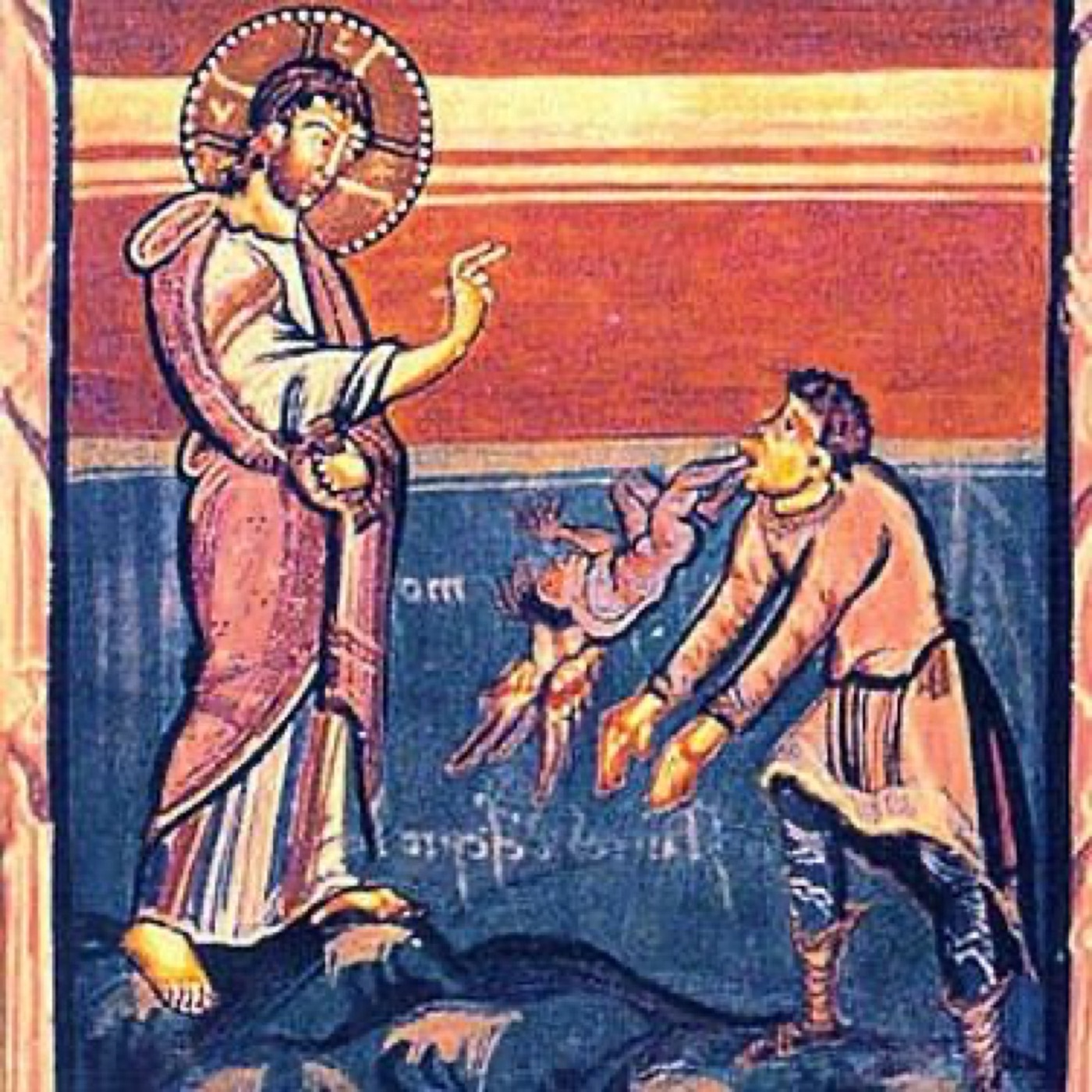
Jesus Heals the Gerasene Demoniac: An Anti-Imperial Take
Exodus and Mark show a people suffering in a certain context—that of Empire. For Moses and the Israelites, the context was the pharaohs in Egypt. For Jesus and the man possessed by demons, the context was the Caesars in the Roman Empire. Whether Pharaohs or Caesars, the belief was that the rulers were beings closer to God than to human beings. God wanted them to rule. Or so went the messaging.
TEXTS
Exodus 14:10-12, 26-30
Mark 5:1-18
Exodus
As Pharaoh drew near, the Israelites looked back, and there were the Egyptians advancing on them. In great fear the Israelites cried out to the Lord.
They said to Moses, “Was it because there were no graves in Egypt that you have taken us away to die in the wilderness? What have you done to us, bringing us out of Egypt?
Is this not the very thing we told you in Egypt, ‘Let us alone and let us serve the Egyptians’? For it would have been better for us to serve the Egyptians than to die in the wilderness.”
. . .
Then the Lord said to Moses, “Stretch out your hand over the sea, so that the water may come back upon the Egyptians, upon their chariots and chariot drivers.”
So Moses stretched out his hand over the sea, and at dawn the sea returned to its normal depth. As the Egyptians fled before it, the Lord tossed the Egyptians into the sea.
The waters returned and covered the chariots and the chariot drivers, the entire army of Pharaoh that had followed them into the sea; not one of them remained.
But the Israelites walked on dry ground through the sea, the waters forming a wall for them on their right and on their left.
Thus the Lord saved Israel that day from the Egyptians; and Israel saw the Egyptians dead on the seashore.
Mark
They came to the other side of the sea, to the country of the Gerasenes.
And when he had stepped out of the boat, immediately a man out of the tombs with an unclean spirit met him.
He lived among the tombs; and no one could restrain him any more, even with a chain;
for he had often been restrained with shackles and chains, but the chains he wrenched apart, and the shackles he broke in pieces; and no one had the strength to subdue him.
Night and day among the tombs and on the mountains he was always howling and bruising himself with stones.
When he saw Jesus from a distance, he ran and bowed down before him;
and he shouted at the top of his voice, “What have you to do with me, Jesus, Son of the Most High God? I adjure you by God, do not torment me.”
For he had said to him, “Come out of the man, you unclean spirit!”
Then Jesus asked him, “What is your name?” He replied, “My name is Legion; for we are many.”
He begged him earnestly not to send them out of the country.
Now there on the hillside a great herd of swine was feeding;
and the unclean spirits begged him, “Send us into the swine; let us enter them.”
So he gave them permission. And the unclean spirits came out and entered the swine; and the herd, numbering about two thousand, rushed down the steep bank into the sea, and were drowned in the sea.
The swineherds ran off and told it in the city and in the country. Then people came to see what it was that had happened.
They came to Jesus and saw the demoniac sitting there, clothed and in his right mind, the very man who had had the legion; and they were afraid.
Those who had seen what had happened to the demoniac and to the swine reported it.
Then they began to beg Jesus to leave their neighborhood.
As he was getting into the boat, the man who had been possessed by demons begged him that he might be with him.
But Jesus refused, and said to him, “Go home to your friends, and tell them how much the Lord has done for you, and what mercy he has shown you. And he went away and began to proclaim in the Decapolis how much Jesus had done for him; and everyone was amazed."
I think we can see some parallels in these two readings which is why I put them into contact with each other. First and foremost, each shows a people suffering in a certain context—that of Empire. For Moses and the Israelites, the specific context was the theocratic monarchy of the pharaohs in Egypt. For Jesus and the man possessed by demons, the specific context was Caesar in the Roman Empire. In both instances, whether Pharaoh or Caesar, the belief was that the rulers were beings closer to God in type than to ordinary human beings. They ruled because God wanted them to rule. Or so went the messaging.
So, it is not incidental that in both stories there are graves, chains of one kind or another, terrible suffering, the military, seas, drownings, chaotic weather, wildernesses, and people who have been brought to stations so low their existence as objects cannot be reconciled with any theology that maintains that human beings are made in the very image of God. The emphasis today is on Jesus’ healing of the man from Gerasa who was possessed by demons. It is helpful, I think, to bring a little background into focus.
First, the sea in the Jesus healing story is the Sea of Galilee which is bisected by the River Jordan. This was the area of the 10 cities of the Decapolis, a league of Greco-Roman cities established as places for Greek settler soldiers to live in after the time of Alexander the Great. In other words, the cities of the Decapolis were places for military occupation.
All but one of the cities, Scythopolis, were located to the east of the Jordan River. Hippo was on the Sea; Gadara and Pella were to the south of the sea; and Gerasa was well southeast of the sea by some 30-40 miles. It was in hilly country.
The entire area, the area of the Decapolis, was solidly Gentile territory. Pigs are a motif in the story. To us Westerners in the 21st century, we think of pigs as being the animal the Jews considered to be unclean. But I think Jesus’ audience may have heard a bit more than that just as when we say “9/11” we mean much more than a date on a calendar. I think it may have been the same with Jesus’s audience
For one thing, the Hellenistic king, Antiochus IV, lit a match when he captured Jerusalem in 167 BCE, then desecrated the Temple by sacrificing a pig on an altar to the Greek god Zeus. This act, called the Abomination of Desolation, culminated in the Maccabean Revolt of the Jews, the victory of which is celebrated in the Jewish festival of Hanukkah. The pig was not only a religious or dietary abomination, it was a political abomination brought on by the arrogance of Empire.
By similar token, the Tenth Roman Legion, which had been stationed in the area for some time, used an image of a wild pig on its standard. The job of the standard bearer was to wave, raise, lower, or make some other motion with his standard to signal a military tactic or formation. Again, the pig had political, imperial meaning in Jesus’ day. The name of the man possessed by demons, so he tells Jesus, is Legion. To say that “my name is Legion” would be today’s equivalent of saying, “my name is COVID-19”. It’s not a name; it’s a reference.
A Legion, as some of you may know, was the basic military unit in the Roman Empire. From the perspective of non-citizens, like the Jews, it was the basic occupying unit of the Roman Empire. It consisted of as many as 6,000 soldiers. But, Pheme Perkins, a specialist in Mark’s gospel and in the early Roman Empire, notes that there were also Legions of about 2,000 soldiers. That is the number that appeals to me, as he does to her, in this reading because we also are given details about the pigs—there was a unit, a herd, and their number was about 2,000.
An often noted motif of Mark’s gospel is the word “immediately”. It appears dozens of times in his gospel. This may not be evident in your translation as some translators are reluctant to use the same translation over and over. The word in Mark’s gospel is “euthys”. The word is so characteristic of Mark that some have called his gospel the “Gospel of Euthys”. What’s the point? The point is that things move. Things happen in Mark’s gospel.
Throughout the Gospels, Jesus has extraordinary powers which are manifested in his ability to perform exorcisms and work miracles. His power was also manifested in natural phenomena—his ability to control the winds and the waters of the sea and his association with clouds. His power was cosmological in scope. What was shocking, especially to Gentiles, was his claim that he was the Son of God—a claim allowable by Caesar alone. His claim was a challenge. It was subversive.
Now, let’s look at the story, as much as we are able, from the perspective of 1st century hearers of the story. Jesus has crossed the Sea of Galilee and is entering militarily occupied Gentile territory. Immediately, the man with demons, the man who lives among the dead, meets him. The Gerasene man, too, is a man of considerable power and is considerably threatening—Mark is emphatic: “no one could restrain him, not even with a chain. He had often been restrained with shackles and chains, but the chains he wrenched apart and the shackles he broke into pieces and no one had the strength to subdue him.”
Yet, the extraordinarily powerful man who resists chains and shackles lives like an animal. He has become a less than human, a pariah socially isolated. Again, Mark is emphatic: he doesn’t moan or cry out or scream, like a human being would. He eternally—night and day—among the tombs and on the mountains, “howls like an animal and bruises himself on the rocks”. Jesus sees him, realizes his is possessed of a demon, and commands the demon, “Come out of the man, you unclean spirit!” We then learn that the man seems not to want Jesus to exorcise the demon even though he has prostrated himself before Jesus. He taunts Jesus in language similar to that of other exorcism stories, “What have you to do with me, Son of the Most High God? I beg you by God, do not torment me!”
Jesus persists, asking the man what his name is. “Legion” replies the man, “because we are many.” This is a nonsense name; it is no man’s name at all; it is a reference to the basic unit of occupation. We might hear it as Jesus’ listeners surely did: “my name is Occupation.” And the man begs Jesus again, do not send them out of the country.”
Listeners in the 1st century may well have made the connection between this man, this chained, bruised, howling, occupied man and the Israelite slaves who, when encountering the possibility of liberation, object: were there not graves enough in Egypt? We would rather be slaves in Egypt than die out here in this miserable wilderness.”And, the hearers of Jesus’ story and Mark’s gospel would remember that Pharaoh was no match for God. They may even be anticipating a twist.
Mark suddenly switches the narrative to the desire not of the Gerasene man but of the unclean spirits themselves. The Legion, the occupiers, astonishingly beg Jesus to defy the man and to send them into the herd of swine. Jesus obliges their request, sends the Legion of 2,000 soldiers into the herd of 2,000 swine. The pigs, unclean in themselves, are now occupied by the unclean demons, the occupying forces, who immediately rush down the steep bank and into the Sea whereupon they all drown. Drown in the sea, covered up by the waters just like Pharaoh’s soldiers and chariots. I wonder whether that bit got a laugh.
But, there is more! The swineherds, the people who tended the swine, Gentiles surely, also stampede, running, to tell what happened in the City and surrounding countryside, the occupied city and occupied countryside. And people began to come out from the City and the countryside to see Jesus for themselves. And they saw the man who had been occupied, delivered of occupation by the Legion, wearing new, clean clothes and, “in his right mind”. Jesus, as the gospel song motif goes, has been a “mind regulator”.
And the people who have come out of the Gentile city and Gentile countryside are afraid. They are afraid of liberation, just as the Israelites in Egypt had been. And they beg Jesus to go away and leave them alone. Just as Jesus in getting back into the boat, the liberated man with clean clothes and a right mind, the man who “had been”, in the past tense, occupied by demons, begs Jesus to let him into the boat.
But Jesus tells him, no, saying that the Gentiles, your own people, need you more than I do. Tell them about what has happened to you and about the mercies, the good things, you have been shown. Which the man does, preaching throughout the Decapolis to amazed audiences. There is no point,
I believe, in reading these stories and trying to make sense of them if we cannot bring them into contact with our own lives. What parallels do we find between ourselves and the Gerasene demoniac, between ourselves and the occupying legions. Are we, too, afraid of liberation? Are we fearful of both the destabilizing threat and the destabilizing promise of the Realm of Heaven on Earth?
That’s it. Grace & peace, y’all. Grace & peace.
← All sermons