Bigots and Ignoramuses: The Scopes Trial
In the midst of the 2016 presidential election cycle, I am struck by the similarity between today's issues and those of the late 19th and early 20th centuries. Corporate wealth and power, free market economic theories, contempt for poor people, and a conclusion on the part of the intelligentsia that belief in evolution and ridicule of biblical creationism as distinguishing features both of smart people and of hopes for national progress characterize both periods.
The Scopes Trial of 1925 encapsulated much of the meaning of the earlier period. It often is understood to have been a simple contest between faith and science in which science was the unmistakeable winner, especially among people who tend to be positioned on the religious, political, and cultural left.
This article will call into question that conclusion. It also will suggest that the Scopes trial has been passed along through American cultural memory in such a way that it is affecting how we are reacting to current issues and populations. It will do so by placing the trial in the contexts both of William Jennings Bryan's earlier career and the social theory he was opposed to—social Darwinism.
THE TRIAL
The State of Tennessee v. John Thomas Scopes, argued outdoors in the heat of July, 1925, was hyped by the press as the “trial of the century”. During the 10 days of the trial, the press dubbed it the “Monkey Trial” in reference to Charles Darwin's theory of evolution. Ostensibly, the trial was to decide whether John Scopes had the right to teach the theory of evolution in a high school funded by the state of Tennessee.
Some historians believe the trial was a straightforward contest between biblical creationism and Darwin's theory that human beings and apes have a common ancestor, in other words between faith and science. Others believe it really was about clashes between modernism and traditionalism, secularism and fundamentalism, urbanism and an eroding rural way of life. Others conclude there were bona fide constitutional issues surrounding separation of church and state, state's rights, intellectual freedom, or free speech.
All of these approaches have merit. However, the attorneys involved in the trial, the state of Tennessee's William Jennings Bryan and Scopes' Clarence Darrow offer insight into something more basic that was going on at Dayton. The trial was, at least in part, a contest between the ridiculed people of America and the self-defined smart people. Here is a revealing excerpt from Darrow's cross examination of Bryan, who agreed to testify for the state of Tennessee:
Darrow: Does the statement, "The morning and the evening were the first day," and "The morning and the evening were the second day," mean anything to you?
Bryan: I do not think it necessarily means a twenty-four-hour day.
Darrow: You do not?
Bryan: No.
Darrow: What do you consider it to be?
Bryan: I have not attempted to explain it. If you will take the second chapter . . . . 'These are the generations of the heavens and of the earth, when they were created in the day that the Lord God made the earth and the heavens,' the word 'day' there in the very next chapter is used to describe a period. I do not see that there is any necessity for construing the words, 'the evening and the morning,' as meaning necessarily a twenty-four-hour day, 'in the day when the Lord made the heaven and the earth.'
Darrow: Then, when the Bible said, for instance, 'and God called the firmament heaven. And the evening and the morning were the second day,' that does not necessarily mean twenty-four hours? Bryan: I do not think it necessarily does. . . .
Darrow: You think those were not literal days?
Bryan: I do not think they were twenty-four-hour days.
Darrow: What do you think about it?
Bryan: That is my opinion—I do not know that my opinion is better on that subject than those who think it does. Darrow: You do not think that?
Bryan: . . . . I do not think it important whether we believe one or the other.
Darrow: Do you think those were literal days?
Bryan: My impression is they were periods, but I would not attempt to argue as against anybody who wanted to believe in literal days. . . .”
At this point, Gen. A. T. Stewart, who was part of the prosecution's team, interrupted to ask, “What is the purpose of this examination?”
Bryan responded: “These gentlemen have no other purpose than ridiculing every Christian who believes in the Bible, . . . .”
Darrow: “We have the purpose of preventing bigots and ignoramuses from controlling the education of the United States . . . .” He went on to say condescendingly of Bryan, “he may be very popular down here in the hills.”
There is it. Those who took the Bible literally—in whatever way they took it literally—were “bigots and ignoramuses”. Those who believed in evolution were the smart people who needed to be in charge of the bigots and ignoramuses.
WILLIAM JENNINGS BRYAN
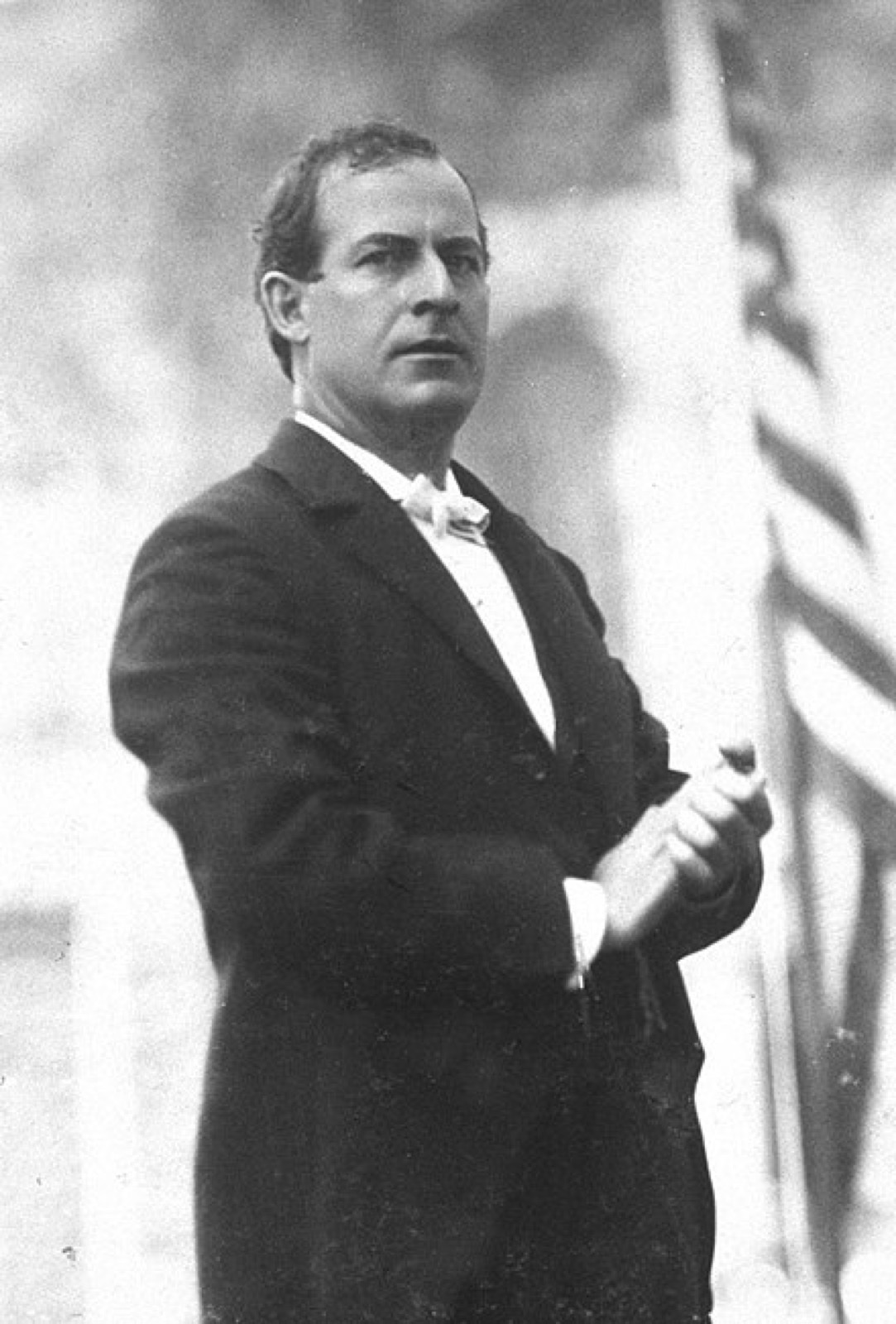
Who were these bigots and ignoramuses? And why did three-time presidential candidate on Democrat tickets, William Jennings Bryan, want to represent them? He was not a theologian or preacher. He was a lawyer and politician who had aimed to serve the interests of laborers for four decades by the time the Monkey Trial had become an international cause célèbre.
As the above excerpt from the trial indicates, Bryan was deeply religious but had never been a biblical literalist. Indeed, the trial excerpt shows that he not only was familiar with the idea of geological ages, he believed they had existed. What many today as then may find perplexing is that he found no contradiction in believing in both geological ages and in the Bible's creation accounts. Yet, that was not an unheard of point of view, even among intellectuals of his day. Harvard lecturer, John Fiske, for example, tried to demonstrate that "in reality there has never been any conflict between religion and science, nor is any reconciliation called for where harmony has always existed." Bryan long had been one of America's most significant champions of the interests of the people Darrow was ridiculing.
In 1896, 1900, and 1908, he had run for president of the United States on Democrat tickets. He also was America's most exciting orator. He had the ability to electrify audiences when supporting such issues as the silver standard. Today, the issue of whether gold or silver should be the standard seems mundane. But it was it's era's version of today's debate over “free market” and “trickle down” economics. Many people believed their lives were hanging in the balance.
Bryan's most important speech and perhaps the most important political speech ever delivered in America was the Cross of Gold speech which he delivered at the Democratic convention in 1896. Interestingly enough for someone who has the reputation today of having been opposed to anything having to do with science, he opened the speech with a reference to atomic theory: “The individual is but an atom; he is born, he acts, he dies; but principles are eternal; and this has been a contest over a principle.” While it was a speech which filtered the populist silver standard through the lens of the Bible and its motif of crucifixion, the majority of the speech, which lasted over an hour, focused on the gold standard itself.
The most overtly religious lines of Bryan's long speech are its famous closing lines:
“If they dare to come out into the open field and defend the gold standard as a good thing, we will fight them to the uttermost. Having behind us the producing masses of this nation and the world, supported by the commercial interests, the laboring interests, and the toilers everywhere, we will answer their demand for a gold standard by saying to them: you shall not press down upon the brow of labor this crown of thorns, you shall not crucify mankind upon a cross of gold!”
The “Great Commoner” as Bryan was known, was a career-long opponent of the banks and the gold standard, an inflexible standard which advanced the interests of bankers, industrialists, railroads, and others of the monied classes. He was a formidable supporter of the flexible silver standard because he believed it undermined the “Money Power” and helped the economic interests of laborers, farmers, and other common people.
He was indeed profoundly Christian. His reading of the Bible, however, persuaded him that politics could not escape having a moral content. He believed that politics encompassed questions of right and wrong. One can hear that here as well as an emphasis on reason rather than force: "The nation is of age and it can do what it pleases; . . . it can employ force instead of reason; it can substitute might for right; it can conquer weaker people; it can exploit their lands, appropriate their property and kill their people; but it cannot repeal the moral law or escape the punishment decreed for the violation of human rights."
SOCIAL DARWINISM
Bryan's opposition to big money and imperialism is intimately connected to the philosophy which he opposed—social Darwinism. In 1925, when he sought to represent the common people of Tennessee, it was not the theory of evolution per se which troubled him. What he was opposed to was the social purposes to which evolution and its corollary—natural selection—already had been applied.
The age in which he was most politically active and most powerful – the Gilded Age and beyond – was an age much like today. Extravagant wealth was concentrated in the hands of a few and ostentatiously displayed while more and more Americans slipped into desperate poverty. It was an age of imperialism, economic expansionism, militarism, laissez-faire capitalism, political conservatism, and severe class stratification.
The philosophical basis for these was a social theory which relied heavily, if often erroneously, on Darwin's theories of evolution and natural selection. It was popular, as you might expect, among wealthy American businessmen, politicians who represented big business, and those who aspired to be among the wealthiest of the wealthy. But, as importantly for purposes of re-examining the meaning of the Scopes trial, the philosophy was articulated and popularized by intellectuals. Among the prophets of social Darwinism were the British philosopher Herbert Spencer and American sociologist William Graham Sumner. Coining the term “survival of the fittest”, Spencer believed that biologically superior people would triumph in the competition for wealth. He once wrote that wealth was a sign of natural superiority and its absence an indicator of unfitness. Sumner used it to justify Adam Smith's “laissez faire” economics, the equivalent of today's “free market” neoliberalism. Spencer presaged the idea that later surfaced in Dayton that those who were weak were “bigots and ignoramuses”. He wrote, “the ultimate result of shielding men from the effects of folly is to fill the world with fools.”
IMPLICATIONS
Our's is an age so similar to William Jennings Bryan's Gilded Age. Corporations pay for the politicians of their choice, trade policies displace peoples and cultures, academics promote trickle-down economics and ministers the notion that God delights in extravagant wealth, poor people are ridiculed and blamed for their own misfortune, and America believes that might makes right. People who believe in creationism are dismissed as “bigots and ignoramuses” while the wealthiest 1% off-shore their jobs and hide their money in tax havens. We would do well to reconsider Bryan, listen closely to his Cross of Gold speech, reflect again on the Scopes trial and ask whether science v. faith was really the issue. We on the left need to ask certain questions of ourselves: Despite any objections we might offer, do we not in some way subscribe to social Darwinism? Do we not harbor the conclusion that wealth accrues to the fittest and poverty to the less fit? Can we really not live with people who don't believe in evolution? Do we really need to insist on a split between science and faith? And, most importantly, what are the consequences of such a split for the people for whom Bryan witnessed so faithfully and for so long?
Additional Sources:
Paxton Hibben, The Peerless Leader: William Jennings Bryan (New York: Farrar and Rhinehart, 1929), p. 220.
Ray Ginger, ed., William Jennings Bryan: Selections (Indianapolis: Bobbs-Merrill, 1967), pp. 234-246. Trial transcript.
Carla Blank, ed., Rediscovering America: The Making of Multicultural America, 1900-2000. New York: Three Rivers Press, 2003, p. 116.